FOR LABORATORY RESEARCH USE ONLY — not for human or veterinary use, diagnosis, treatment, or cosmetic application. Buyers must be 21+ and legally permitted to purchase research chemicals in their jurisdiction.Intended-use statement →
Retatrutide Wholesale
Triple receptor agonist — the next frontier in multi-pathway metabolic research
Product Identity
| CAS Number | 2381089-83-2 |
| Amino Acids | 39 residues |
| Molecular Weight | ~4,845.5 Da |
| Linker | C20 Fatty Diacid |
| Receptor Targets | GIPR · GLP-1R · GCGR |
| Appearance | White to off-white lyophilized powder |
| Purity | ≥99% by HPLC |
| Storage | 2–8°C, desiccated, protect from light |
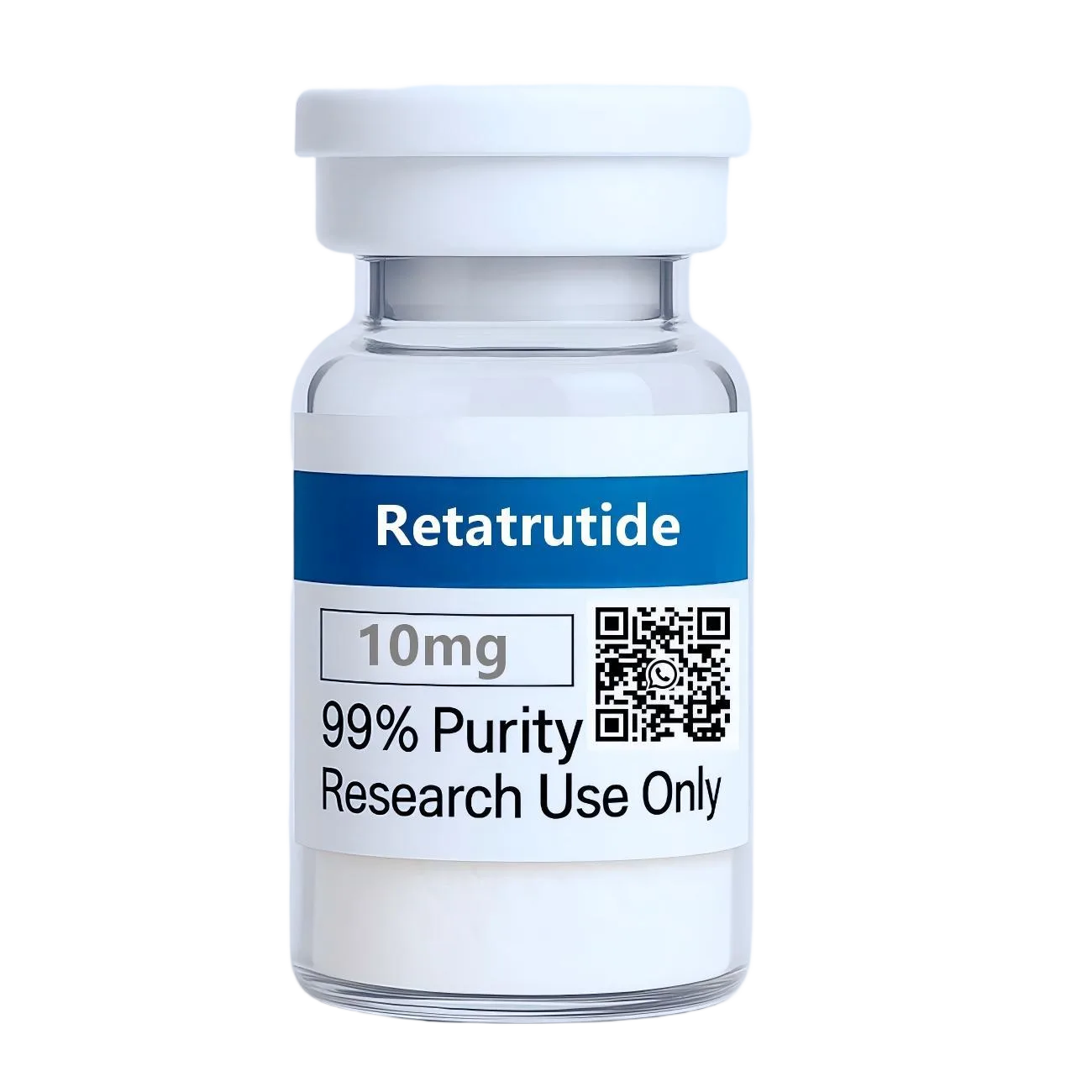 Factory-direct
Shenzhen, China
Available Configurations
| Configuration | Content | Best For |
|---|---|---|
| Standard Kit | 5 mg × 10 vials | Standard research format |
| Bulk Kit | 10 mg × 10 vials | Higher-dose configuration |
| Extended Kit | 15 mg × 10 vials | Extended research format |
| Custom | Custom mg × custom vials | OEM; private-label |
Research Background
Retatrutide is a 39-amino acid single-chain peptide engineered with balanced triple agonism at GIP, GLP-1, and glucagon receptors. The addition of GCGR agonism — driving energy expenditure through thermogenesis and lipolysis — distinguishes Retatrutide from dual agonists. A C20 fatty diacid linker provides albumin binding for extended half-life, enabling sustained triple-receptor engagement from a single molecule.
Proposed Mechanisms
Research Focus Areas
GCGR component uniquely boosts thermogenesis — absent in GLP-1-only agents
~24% mean reduction at maximum research doses — triple-receptor mediated
Triple-redundant glucose control via GIPR insulin sensitivity, GLP-1R insulin secretion, GCGR hepatic output
Coordinated lipid mobilization across WAT lipolysis (GCGR) and lipid buffering (GIPR)
Quality Specifications
| Parameter | Method | Criterion |
|---|---|---|
| Purity | RP-HPLC, C18 column, 220nm | ≥99.0% |
| Identity | ESI-MS | MW match within ±1 Da |
| Peptide Content | Amino Acid Analysis | 80–90% (net peptide) |
| Acylation Fidelity | LC-MS | Confirmed C20 diacid conjugation |
| Water Content | Karl Fischer | ≤8% |
| Trifluoroacetate (TFA) | Ion Chromatography | ≤1% |
| Appearance | Visual | White to off-white lyophilized powder |
Tiered Wholesale Pricing
| Kit size | Code | List price |
|---|---|---|
| 10 mg × 10 vials | RT10 | US$58 |
| 15 mg × 10 vials | RT15 | US$79 |
| 20 mg × 10 vials | RT20 | US$101 |
| 30 mg × 10 vials | RT30 | US$138 |
| 40 mg × 10 vials | RT40 | US$185 |
| 50 mg × 10 vials | RT50 | US$233 |
| 60 mg × 10 vials | RT60 | US$259 |
US$58–259 per kit (10 vials), from our published wholesale price list; tiered volume discounts apply (see the tier table) — source:wholesale price list (PDF, updated 2026-08-08).
| Volume | Discount | For |
|---|---|---|
| 1 kit | List price | Evaluation; competitive analysis |
| 5+ kits | 10% off | Initial portfolio expansion |
| 20+ kits | 20% off | Mid-size distributors |
| 50+ kits | 30% off | Regional distributors |
FAQ
What is the difference between Retatrutide and Tirzepatide?
Retatrutide adds a third receptor target — the glucagon receptor (GCGR) — to the GIP/GLP-1 dual agonism of Tirzepatide. The glucagon component drives increased energy expenditure and lipolysis. Published data show ~24% body weight reduction with Retatrutide compared to ~21% with Tirzepatide at maximum research doses.
Why is Retatrutide more difficult to manufacture?
Retatrutide's complexity arises from engineering balanced triple-receptor agonism into a single 39-amino-acid peptide. Achieving the correct potency ratio across GIP, GLP-1, and glucagon receptors requires precise amino acid substitutions and the C20 fatty diacid linker. Each receptor's activation profile must be tuned so that none dominates or is suppressed.
How should Retatrutide be reconstituted for research?
Retatrutide is supplied as a lyophilized powder and is typically reconstituted in bacteriostatic water or sterile buffer at your laboratory's validated concentration. Full solubility data is included in the batch-specific COA. After reconstitution, use within your protocol-validated timeframe.
Can I order Retatrutide with private labeling?
Yes. We offer OEM/private-label services for Retatrutide with custom vial branding, labeling, and packaging. Minimum order quantities apply for private-label runs. Contact Dr. Aaron Wang for a private-label quotation including lead times, artwork specifications, and MOQ details.
All products are manufactured for laboratory research purposes only. Retatrutide is labeled FOR LABORATORY RESEARCH USE ONLY. Not for human or veterinary use, diagnosis, treatment, prophylaxis or any clinical, cosmetic, dietary or household application. Not a dietary supplement, pharmaceutical ingredient, cosmetic ingredient or approved drug substance. Buyers are responsible for verifying the legal status of importation and possession in their destination country. Incretin analogues are prescription or investigational substances in many jurisdictions — buyers must confirm the legal status of importation and possession, and hold any required authorisation.
Ready to Source Third-Generation Metabolic Peptides?
Triple agonism, batch-traceable, ≥99% purity. Contact Dr. Aaron Wang for pricing and availability.